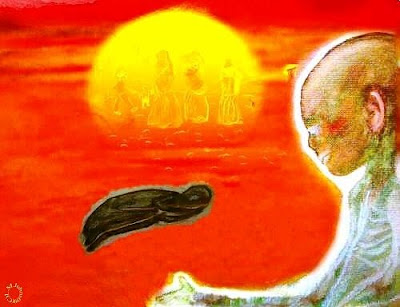
Kisumu residents suffered some of the post-2008 election violence, artists like Willis are using art to begin to heal their community.

*
*

He pulled on jeans and a tee shirt and sat down to enjoy a cup of hot cocoa. On an afterthought he sent a classmate going to the tuck shop to buy him milk, a chapatti and a samosa. The usual black tea and half loaf of bread would not suffice. “Keep the change bro, we’re on a roll!” he cheerily told his classmate. The other boy smiled lightly at the measly five bob.
Later, as Muli walked down the stairs of Hall 9, he imagined everybody staring at him, fascinated. They’d probably seen his story in the paper. A few boys greeted him in what Muli could only construe as tones of admiration and awe. He entered the custodian’s office where the 900 boys read the daily from. Leafing through it with about 10 others, he pointed at his story, proudly telling them, “Yeah, that’s me!” He remained there for an hour, pointing out the story to all incoming readers till he was sure he’d left a fair number to tell others on his behalf.
At midday he sauntered to town to buy his own paper. He stopped at the first newspaper vendors. “Two copies of the Un-standard please,” he ordered. “My stories are in it today...” he added for good measure. Unfortunately, the newspaper wasn’t there. Sold out, the vendor told him. Muli moved on to the next stall. Three hours later he was still without a paper. Apparently they had all sold out. Muli stood exasperated. “What’s happening today,” he asked, “why are they sold out everywhere?” The woman selling shrugged. “Hasn’t happened in a long time. Only happens when they carry very serious stories.” Muli stopped short, transfixed at her words. “Say no more!” he beamed and set back for school.
Was his story that good that the papers had sold out? “Can’t be,” he tried to convince himself unsuccessfully. “I shall not tell this to any one though” he vowed “or else they’ll say that I’m bragging like they always do.” And so tight-lipped and with the expression of a pained martyr, he returned to campus. Let them hear of the awards I will win for themselves. I will not be the one to tell them, he thought, referring to his literature classmates. He spent the remainder of the day huddled in his room, fantasizing about his next great story. This one would change the world for sure…
Fortunately, he missed the evening news. The news anchor was reporting on repression of media freedom. The top news for the day was: ‘Government buys out all Un-standard papers and sets them ablaze and raids media house’. Apparently the front pages contained an expose of grand corruption by top government officials. Police had bought up all newspapers in town that day and raided the media house to prevent them printing the next day’s paper which was equally ‘seditious’. Upstairs, Muli scribbled down more profound thoughts.
©KingwaKamencu2009


Welcome to k!3, where Kenyan writer Richard K responds to his experience of an IDP camp in Gulu, Uganda, in prose and poetry, and Louisa M.J. in Wales responds to his words using digital and acrylic media . Coming up in the next issue : Traditional artist Sanaa Gateja paints on barkcloth, his pupil Kateeba Anthony prefers a more modern approach - kushinda! explores their techniques, motives and inspirations. Past Issues : k!2 Matt Bish on Ugandan films k!1 music, art, theatreThe bright sun moves down the cloudless sky yet another day
Over the desperate eye of an expecting soul,
Its ominous heat burning the earth to red ash
And the whirls gathering the ash into dust.
The wind has not won the fight
To drive the red dust away,
Neither has the rain come trickling down
To cool the boiling souls to hope.
The expecting eye wanders away
To seek the face of an approaching visitor,
The heart runs but the lips remain tight.
And oh, the silence!
The hardly covered bodies,
Their beginning-to-bulge bellies,
The scarcely-haired scalps,
The parentless kids,
The kidless parents,
The innumerable beads of mud shacks,
The numerable grains on infected floors,
The spectacle of searing hope under the Gulu sun!
Is it not a sad story?
The children are sick of the disdain,
The children wish to laugh again
And play and run home to warmth again,
But who has called their mercies forth,
And shaken their hands free,
To cradle the children to their breast
When they come running to them?
The van move
s at a very slow speed on taking the dusty road as if afraid of venturing further down and, led by Dennis Kimambo in the words of some Alma mater lyrics that he sung to his high school bus driver, and in chanting some Kenyan matatu, hyped up whimsical we encourage the driver to keep pressing the accelerator ever harder. I am sandwiched between two beautiful Ugandan ladies and listening to one Joanita Nambi on my right who relates to me the challenges she is encountering trying to sell the ABC ideals of Roll Back AIDS , but I am not fated to concentrate entirely since the van keeps sucking in dust that has now almost suffocated us. The creaking sound of the old loose metalwork scares me and I am afraid that the chassis will give in under the pressure of our load as the van keeps coming down hard upon the bumpy road. My fears are almost consummated when Christina's car, in the dexterous hands of our friend George, fires fast past us leaving behind it a monstrous cloud of red dust that swallows us, obscuring almost everything, but luckily the van does not veer off to hell as I was fearing.
There are three modern buildings on the one side of the narrow pathway that deviates a short distance off the main road into the camp. One of the buildings is a pavilion with the resemblance of a mystical shrine while the other two hold the offices for charity and other welfare services. In one of the rooms an adult education class is in progress and I am worried lest we be mistaken for tormentors when we rush in interrupting, but George, swiftly as always, intercedes for the entire group in a translated explanation not only of who we are but our mission here as well. Outside a group of half-naked children - most of whom bear two shiny stripes stretching between nose and mouth, a trademark of an ailing infant population – mills around the building like disheveled scavengers milling around a feasting pride of wild cats. I want to sit for a photo with them but when I beckon to them to congregate some tall boys, (from whence they appear is a puzzle to me), with forbidding countenances warn them against what I conjecture as mixing with or bothering the visitors. Nevertheless I remain adamant until at last the children submit to my persuasion and Paul, Madi and I in turns seat ourselves for photos with the children, who cling to our trousers like they shall never let go. The children's eyes remain glued to the empty mineral water bottle that I am holding, luckily I manage to quickly dispose of it without their noticing.
Across the other side of the pathway, when we turn to look, the actual camp stands - a regrettable vista of a multitude of tiny thatch and mud huts that seems to extend ad infinitum . Charity and I are in front leading the group into the camp but we are halted to give room for George's vanguard. Meanwhile, Charity and I challenge each other to discover the purpose of an unroofed hut, much smaller than the rest, that stands on the camp threshold like a ghost some ten metres or so away from the next hut. I am utterly disturbed on tugging at the gaping door, not by the appalling stench that suddenly screams into my nostrils but by the mound that has formed through accumulation of continual defecations and the some-inches-deep footprints upon it that make it look like a large ghostly face, mockingly staring,that seems to have stifled the stench until the moment we peer through the door. The other huts are about the size of a soccer pitch center circle or smaller and each is just a few centimetres away from the other as if one would not stand up alone . There is however enough room for paths about the camp but the striking closeness of the huts has a rather profound meaning: the extent to which the magnetism of common social predicament has pulled the compact of the people of the camps tightly together. As we walk about the camp I note that much of it is deserted save for a few people, most of whom are old folks. These, like the children, are poorly dressed and look rather emaciated. One cannot help but notice their scantiness accentuated by the amount of grains (enough to feed a single hen for two days), predominantly maize and sorghum, drying on the floors. Outside another hut I notice a heap of cones of some local fruit (is it wild or not?) but I do not comprehend whence the cones come or what they are for until we nearby encounter some men - I am not sure if youthful or otherwise - who are gradually soaking in some intoxicating local flavour and when those behind us salute them the men mockingly intonate in some bad Kiswahili.
It does not takes us long to emerge on the other side of the camp where we find the shopping centre comprised of, as the rest of the camp, fabricated buildings of mud. The children, those who attend, are returning home from school and Njoki and Brenda lead the rest of the group in singing some songs. Sweets are bought for the children and some kind words are exchanged. I am finding the urge to have another puff irresistible and so I cross to the other side of the road, lest I set the grass thatched camp ablaze,to light my cigarette . Thinking about accidental fire attracts me to the consideration that I can almost hear the scarcely green grass cracking under the immense heat. I also re-examine my need to smoke while those children have hardly enough for dinner, but I succeed in consoling myself that it makes little difference if I, after all, puff out my stick now or not.
Much calmer than when we came we ride back in almost muted silence. I go straight to the lady who had fueled the desire to visit the camps and I find courage to express my most sincere gratitude to Christina and the LiA Centre on the one hand and the Charity for Peace on the other for the wonderful work they have done, and continue to do, for the children and the impoverished people. It is my hope that many more people will be touched by the spectacle of wretchedness evident in the camps and will be inspired to do something to improve lives there.
Words : Richard K, Kenya
Pictures : Digital and acrylic montages by Louisa M.J, Wales
Q From what I read, Kinna Uganda seems to be very much a home-grown, grassroots phenomenon, springing from an established tradition of theatre and stage-acting. Given that film and theatre rely on very different techniques of acting and production, how much do you think the theatrical tradition helps or hinders the development of film making as an industry in Uganda?
A I believe “Kinna Uganda” to some extent does help prepare so many individuals in their respective professions for film and similarly destroys the many would be professionals in the film industry. Why? From my own interpretation, after watching several “kin-Nigeria” movies while I was in film school, I came to the conclusion that any film industry with the “KINNA-something” tag meant that the industry in question was abusing the art of filmmaking. Filmmaking is an art that encompasses all other arts known to man. These may include: Poetry, music, acting, fine-art, writing etc…but our friends in Nigeria don’t respect film as an art. Take a good example of films from Senegal by Ousman Sembene. His films were great and the film industry in Senegal is highly appreciated by film professionals around the world, the reason why they hold a film festival that embraces all beautiful movies made around the world from Africa and the Diaspora.
Ugandans know that these films (kinna-something) are of low quality but they insist on watching them because the films are really entertaining. So, if a low budget movie (kinna Uganda) can get them entertained why then spend so much money on the same movie?
Professions affected here include: Sound recordings, Camera persons (D.O.P)s, Set designers and Production designers, Score composers and Sound designers, etc…
The actors too tend to become rigid and will take too long to understand the differences between the two Arts (Theater and Film). It can take a while during rehearsals before they understand what is required of them.
On the other hand, theater has helped some talents improve in the fields of writing, set designs, costumes and special effects. Individuals will borrow these ideas and present them to their film which for a start isn’t bad at all.
Simply put, “Kinna-Uganda” would mean poor quality films made for entertaining the locals.
Q As an overseas viewer I was immediately struck by the importance of symbolism in 'Battle of the Souls' .
The theme of 'going under water' in particular made me think of traditional associations in Welsh and European historical culture of lakes, wells and rivers being associated with spirits and gateways to 'the otherworld' . Of course immersion in water is also a Christian tradition. I am curious as to why you made such a strong association between water and 'the Devil' in your film, is that association a prominent one in Ugandan culture or is it a less well known theme which you chose to develop into a major one specifically for the film?
Wycliffe in the movie interacted with the three boys as a human being with evil powers and during the exorcism of Ryan it was clear that, while all that was happening, his spirit had gone under to face the demons.
This is also very much fictional but I tried to show my own understanding of going under.
A I guess both aspects are important because Ugandans definitely love to be entertained and its only through entertainment that you can reach the masses of people. We are living in a time where child sacrifices are the main talk of everybody. More than 113 children have gone missing and quite a number have turned up dead. Most of these deaths have been connected to the very rich people who want to appease their gods. It is quite timely that they have the chance to watch this film and understand where its coming from and what message it carries.
Kinna-Uganda can help a great deal in educating people with their moral values and reaffirm their belief in God.
It also doesn’t have to be Kinna Uganda to do that. Great films meant for African audiences can help reach out to individuals and do the necessary.
Films about AIDS are always encouraged. Tribal conflict isn’t really that interesting unless if you are telling a story about the origin of kingdoms. When you concentrate on just entertaining, I feel as an African, that you haven’t used the chance of film to do what is African, that is teach, help spread the word, etc..
Q Finally, what's next for you as a film-maker? Do you have plans for another film, and if so can you give your fans an idea of what we have to look forward to ?
A I’m definitely putting together something. It’ll come and it will be a lot better than the first. That was rather experimental to me…just tasting the waters. That’s all I can say.
Huge thanks to Matt for responding so generously to my interview request, and equally huge thanks to IDTwins for making it possible.
Pics from top to bottom
Matt Bish
'Ryan' (film still)
Battle of the Souls
Battle of the Souls is available on DVD from Wasswa Hassan of Twinex Videos Ltd and Media Pro Ltd, Kampala, Uganda. Do buy it, I did !

kushinda! is about promoting African artists, musicians, writers, creative people and projects, and helping them reach new audiences online. It will look something like an online magazine or journal, as it grows it will help artists and arts-based organisations to connect with sponsors, customers, and eachother!
art music community theatre children's drama club
Moud has been painting professionally since the age of 15. Like most African people I have met in this wonderful online world of ours he has had many trials to overcome in his life, being orphaned in childhood and having to drive himself towards his ambitions with little more than the will to succeed. Like many others also he does not forget those who are facing today the same hardships and challenges as he himself has faced, and has given freely of his time to guide and encourage young artists and would-be artists by holding workshops for the Kampala Junior Team. He currently has his own gallery and framing service in Kampala. Recently, many of his paintings were exhibited in Texas, USA. You can see more of Moud's paintings at his blogsite or visit our art! page, where you will find more of his work and contact details.
This week's feat
ured musicians are idtwins - Kato and Wasswa, occasionally joined by their friend Denis, sing in Luganda, Swahili and English. Their music has a bright and lively sound which always makes me think of sunshine (something we need more of in my home country of Wales!) . Their songs reflect the positive spirit of youth and celebrate the opportunities life brings, whilst reminding those in authority of their obligations to manage their world to the mutual benefit of all and especially to those who suffer the consequences of poor planning and divisive policies. 'Mr Kampala', for instance, warns against the dangers to health and wellbeing in the city when basic health facilities are not provided and tribal rivalries allowed to interfere with progress. 'Kama Mbaya Mbaya' tells of the possibilities which open up when young people find work and are rewarded not just with money but with self-respect and a greater sense of control over their own destinies. Of course they also sing of love and the pleasures of living! Listen to them on iLike now!
Kenyan community theatre Repacted and and the children's drama club of the Kampala Junior Team are two examples of organisations using the theatrical arts to explore and educate about health and social issues. Repacted work with older children and young adults in and around Nakuru, Kenya, taking their community theater workshops i
nto prisons, towns and rural areas. The Kampala Junior Team work with girls and boys aged 6 and above in the Kisenyi slum district in
Kampala, Uganda. Strikingly these two organisations, despite the difference in age groups, share many of the same aims and concerns and both recognise the great potential of this branch of the arts for raising awareness of, and stimulating debate about, such serious and difficult issues as sexual health, gender equality, and tribal conflict. But wait a second, that doesn't sound like much fun, what could you gain from that experience that you couldn't get from a newspaper or a lecture? What makes art, be it theater, music, film, poetry or painting, so special? How is it we are moved by abstract paintings, or a song that is sung in a foreign tongue? How can a story, made up but well told, teach us more about ourselves than a text book full of facts? And just how special are the people who make these things happen?
What do you think? kushinda! would really like to know!